

Angel Rubio: Cavity Quantum Electrodynamics in 2D Materials: Photon-Mediated Interactions and Materials Engineering
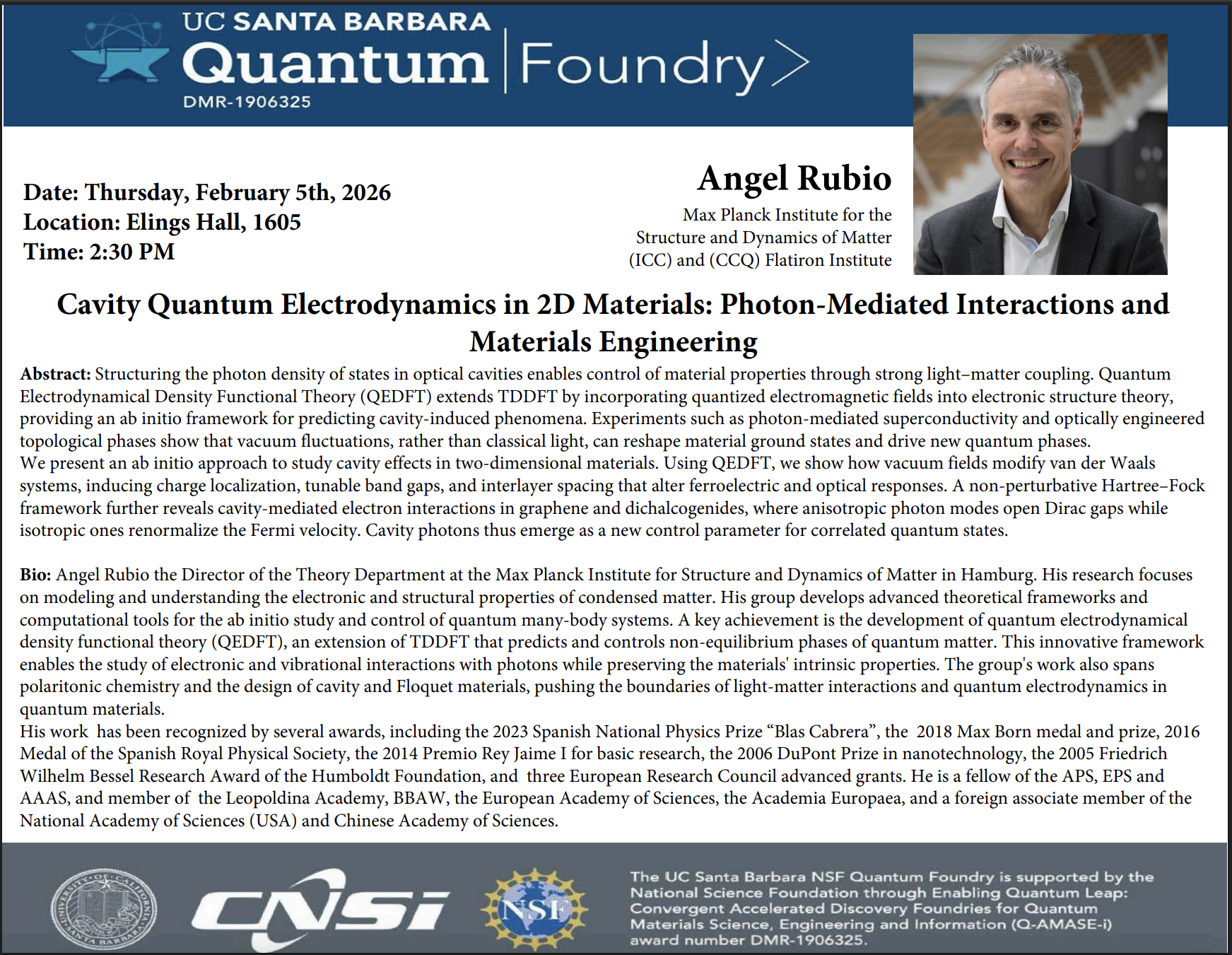
Abstract: Structuring the photon density of states in optical cavities enables control of material properties through strong light–matter coupling. Quantum Electrodynamical Density Functional Theory (QEDFT) extends TDDFT by incorporating quantized electromagnetic fields into electronic structure theory, providing an ab initio framework for predicting cavity-induced phenomena. Experiments such as photon-mediated superconductivity and optically engineered topological phases show that vacuum fluctuations, rather than classical light, can reshape material ground states and drive new quantum phases. We present an ab initio approach to study cavity effects in two-dimensional materials. Using QEDFT, we show how vacuum fields modify van der Waals systems, inducing charge localization, tunable band gaps, and interlayer spacing that alter ferroelectric and optical responses. A non-perturbative Hartree–Fock framework further reveals cavity-mediated electron interactions in graphene and dichalcogenides, where anisotropic photon modes open Dirac gaps while isotropic ones renormalize the Fermi velocity. Cavity photons thus emerge as a new control parameter for correlated quantum states.
Bio: Angel Rubio the Director of the Theory Department at the Max Planck Institute for Structure and Dynamics of Matter in Hamburg. His research focuses on modeling and understanding the electronic and structural properties of condensed matter. His group develops advanced theoretical frameworks and computational tools for the ab initio study and control of quantum many-body systems. A key achievement is the development of quantum electrodynamical density functional theory (QEDFT), an extension of TDDFT that predicts and controls non-equilibrium phases of quantum matter. This innovative framework enables the study of electronic and vibrational interactions with photons while preserving the materials' intrinsic properties. The group's work also spans polaritonic chemistry and the design of cavity and Floquet materials, pushing the boundaries of light-matter interactions and quantum electrodynamics in quantum materials. His work has been recognized by several awards, including the 2023 Spanish National Physics Prize “Blas Cabrera”, the 2018 Max Born medal and prize, 2016 Medal of the Spanish Royal Physical Society, the 2014 Premio Rey Jaime I for basic research, the 2006 DuPont Prize in nanotechnology, the 2005 Friedrich Wilhelm Bessel Research Award of the Humboldt Foundation, and three European Research Council advanced grants. He is a fellow of the APS, EPS and AAAS, and member of the Leopoldina Academy, BBAW, the European Academy of Sciences, the Academia Europaea, and a foreign associate member of the National Academy of Sciences (USA) and Chinese Academy of Sciences.
