

Prof. Karl Unterrainer
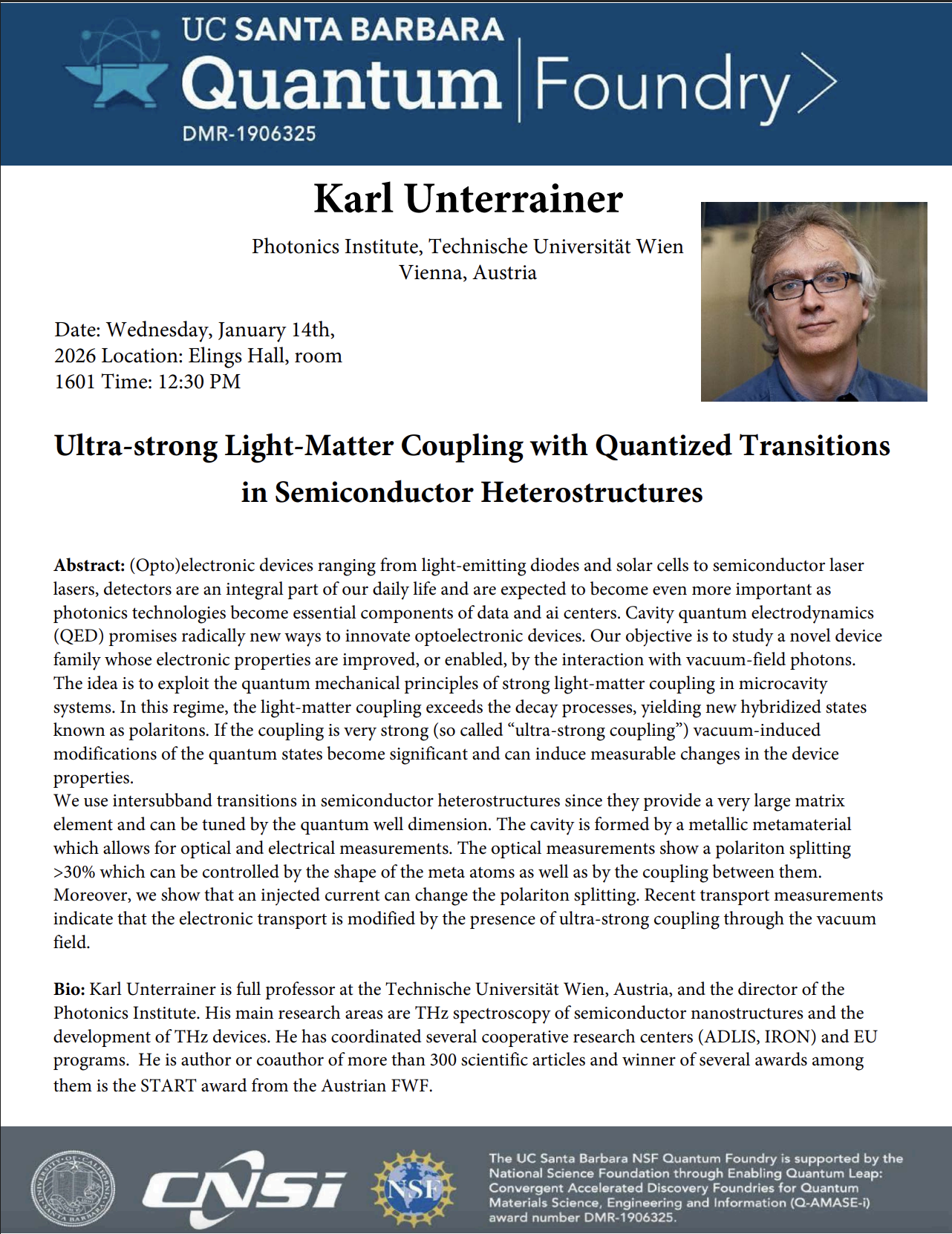
Ultra-strong Light-Matter Coupling with Quantized Transitions in Semiconductor Heterostructures
Abstract: (Opto)electronic devices ranging from light‐emitting diodes and solar cells to semiconductor laser lasers, detectors are an integral part of our daily life and are expected to become even more important as photonics technologies become essential components of data and ai centers. Cavity quantum electrodynamics (QED) promises radically new ways to innovate optoelectronic devices. Our objective is to study a novel device family whose electronic properties are improved, or enabled, by the interaction with vacuum-field photons. The idea is to exploit the quantum mechanical principles of strong light-matter coupling in microcavity systems. In this regime, the light-matter coupling exceeds the decay processes, yielding new hybridized states known as polaritons. If the coupling is very strong (so called “ultra-strong coupling”) vacuum-induced modifications of the quantum states become significant and can induce measurable changes in the device properties. We use intersubband transitions in semiconductor heterostructures since they provide a very large matrix element and can be tuned by the quantum well dimension. The cavity is formed by a metallic metamaterial which allows for optical and electrical measurements. The optical measurements show a polariton splitting >30% which can be controlled by the shape of the meta atoms as well as by the coupling between them. Moreover, we show that an injected current can change the polariton splitting. Recent transport measurements indicate that the electronic transport is modified by the presence of ultra-strong coupling through the vacuum field.
Bio: Karl Unterrainer is full professor at the Technische Universität Wien, Austria, and the director of the Photonics Institute. His main research areas are THz spectroscopy of semiconductor nanostructures and the development of THz devices. He has coordinated several cooperative research centers (ADLIS, IRON) and EU programs. He is author or coauthor of more than 300 scientific articles and winner of several awards among them is the START award from the Austrian FWF.
